
Apartments That Accept Evictions in Dallas
Have an eviction? Learn the difference between a filing, judgment, and dismissal, which DFW properties approve anyway, and what they require.

Our perfect-credit clients are used to fast approvals, cash rebates, and free moving services, but finding apartments that accept evictions dallas requires a different strategy.
Those premium perks are standard for pristine applications. An eviction changes the entire screening landscape. We see daily how Dallas-Fort Worth communities evaluate eviction-flagged renters by carefully reading the civil court record.
Property managers look at the case type, the final outcome, how long ago it happened, and your current financial situation. That specific detail makes approval possible.
Our team will break down the exact screening factors properties use and walk through practical ways to find a new place. Let’s look at the data and explore a few practical ways to respond.
What apartments that accept evictions dallas see on screening
When a property manager runs an applicant with an eviction flag, they typically see a detailed court timeline. The screening software pulls the specific case type, the date, and the final ruling from the county database.
- The case type: This is usually a forcible entry and detainer action filed in justice court.
- The case outcome: The record shows a judgment for the landlord, a dismissed case, or a settled agreement.
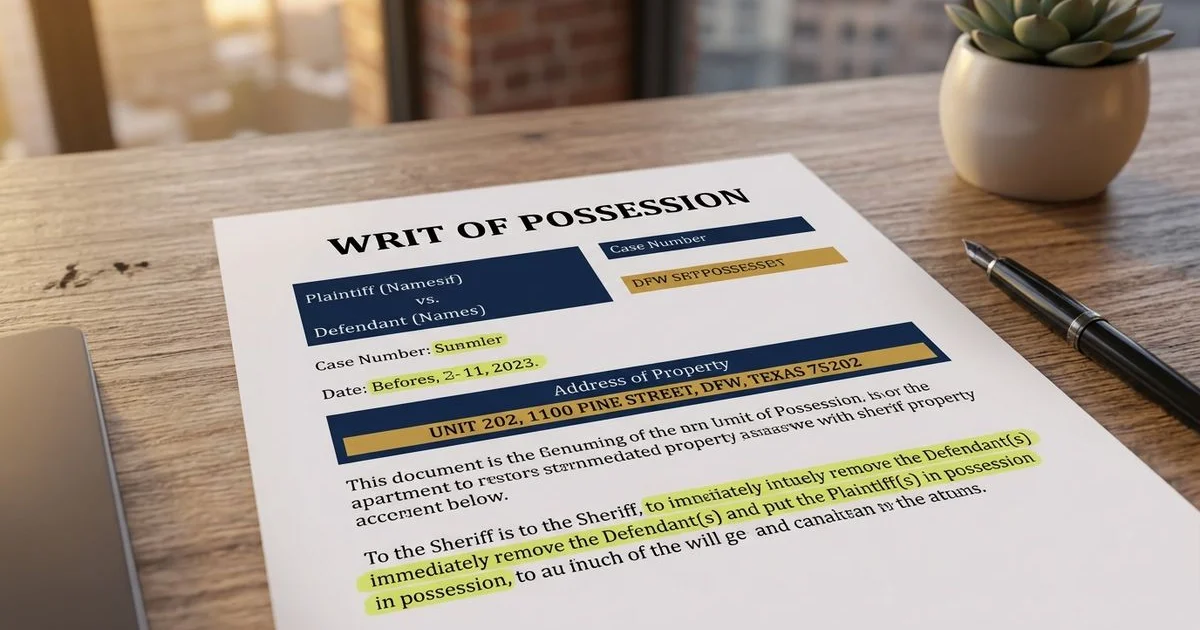
- A writ of possession: This appears if a judge issued the order and a constable served it.
- An open balance: Any unpaid or settled financial balance will show up if applicable.
- The case date: Software compares this date against the community’s specific lookback period.
Our analysts know that a 14-month-old final judgment with a writ and an open balance is a vastly different story than a four-year-old dismissed filing with no balance. Property managers running hybrid-approval criteria easily distinguish between the two.
The Fair Credit Reporting Act allows these records to stay visible for seven years. Many Dallas property managers set their software lookback periods between two and seven years, depending on the property class.
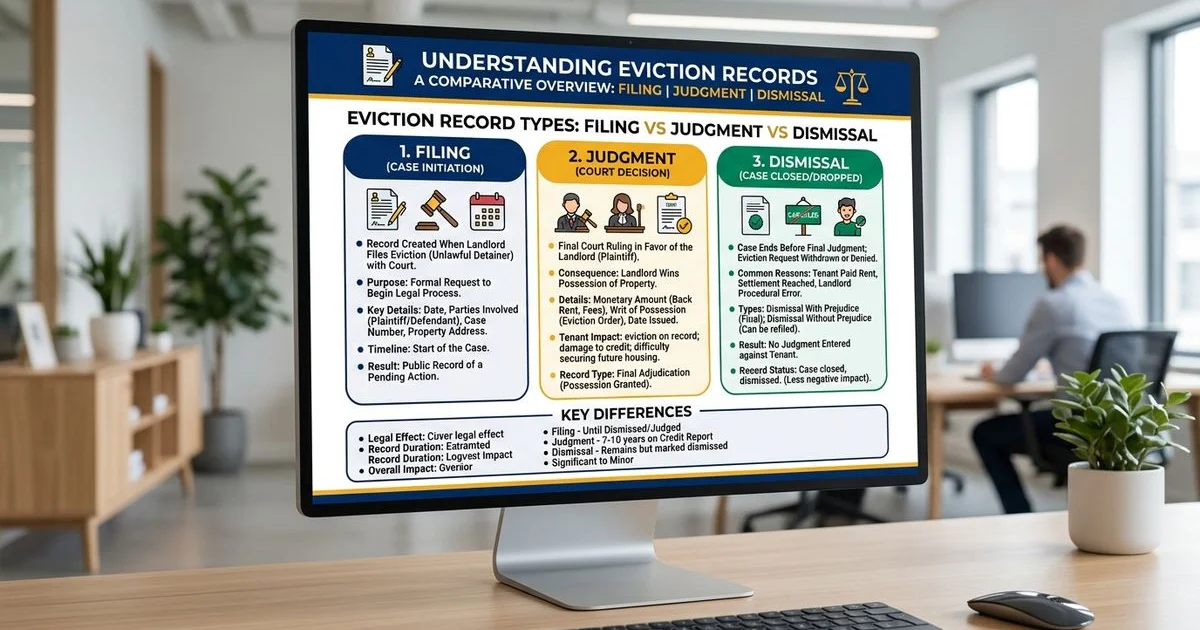
Filing vs judgment vs dismissal, plain English
The outcome of your court case dictates your approval odds. A simple filing is much easier to overcome than a final judgment.
The Impact of a Filing
The landlord initiated the case in justice court. Filing alone, without a final judgment, is the lightest record on your profile. Many DFW hybrid-approval communities approve filing-only cases at the standard tier. Senate Bill 38, effective January 1, 2026, tightened court timelines. A simple filing can turn into a final judgment in just a few days if ignored.
Facing a Final Judgment
The court ruled in favor of the landlord, making this the heaviest record to carry. Hybrid-approval communities can still approve this outcome, provided you offer strong offsets:
- Verifiable proof of current income exceeding the minimum requirement.
- A formal settlement letter from the previous landlord.
- Acceptance of conditional-approval terms, such as a higher deposit.
The Benefit of a Dismissal
The judge dismissed the case for a procedural reason, or the landlord withdrew it. Property managers weigh a dismissal far lighter than a full judgment. Approval at the standard tier is common.
Reaching a Settlement
The case was resolved by a formal agreement between you and the landlord. This outcome is often associated with a settlement document (see Pay-and-Stay vs Settlement Letters vs Hybrid-Approval Properties).
Before you pay any fees, you need to know a crucial legal change. In 2025, the Texas Property Code updated tenant screening laws to mandate written disclosure of selection criteria. Landlords must provide a printed list of their exact eviction policies before accepting your application check.
Our locating team always advises requesting this document upfront. This prevents you from wasting $50 to $100 on non-refundable application fees at properties with zero-tolerance judgment policies.
Which DFW communities approve eviction-flagged files
Hybrid-approval communities take the time to read the whole file. These are typically garden-style and older mid-rise stock in Arlington, Grand Prairie, Oak Cliff, and Garland. Class A high-rises in Plano, Frisco, and newer Uptown construction tend to run stricter criteria with hard lookback rules.
Our perfect-credit renters easily secure cash rebates and free movers at those Class A properties because the automated screening favors pristine histories. Locating eviction friendly apartments dfw communities requires a shift toward property managers who perform manual reviews. To successfully rent with eviction dallas locators recommend targeting garden-style properties.
Your application path depends on several key factors:
- Type of record, such as a filing, judgment, or dismissal.
- Time since the case, which software compares to the local lookback period.
- Whether any landlord debt is currently outstanding.
- Your gross monthly income and employment stability.
- Your verifiable rental history since the court date.
| Property Type | Common Locations | Screening Approach | Eviction Tolerance |
|---|---|---|---|
| Hybrid-Approval (Garden Style) | Oak Cliff, Arlington, Garland | Manual file review | Flexible, considers age and case outcome |
| Class A (Luxury Mid/High-Rise) | Uptown, Plano, Frisco | Automated algorithm | Strict, typically 7-year hard lookback |
What property managers want to hear
A clean, brief written explanation of the situation goes a long way. Most second-chance approvals clear at hybrid communities without much friction when the renter is honest about what happened, what changed, and what they can show today.
Providing strong income statements, reliable references, and proof of no recent issues gives the manager a reason to approve you. The opposite approach usually triggers an automatic decline even at flexible communities. Giving vague or evasive answers when the record is completely visible on a Dallas County civil court search damages your credibility.
Our experience shows that preparation makes the difference. The full path to approval is detailed in the Eviction & Broken Lease Apartment Locating hub. When you are ready to tour apartments that accept evictions dallas, tell us your situation and our locating team will line up the right list within 24 to 48 hours.
Frequently asked questions
Can I rent with an eviction on my record? expand_more
Does a dismissed eviction still show up? expand_more
What is a writ of possession? expand_more
Do all eviction records show up the same way? expand_more
Related service
Free locating for renters with an eviction, broken lease, or unpaid landlord debt across DFW.
See Eviction & Broken Lease