Last updated
When credit or income alone is not enough, a third-party guarantor service or a personal co-signer can close the gap between approval and another denial. We find the Dallas-Fort Worth communities that partner with platforms like TheGuarantors, Rhino, and LeaseLock, or accept a traditional co-signer, and confirm exactly what each property requires before you apply.
Dallas Second Chance Apartments is a free guarantor and co-signer apartment locating service covering the entire Dallas-Fort Worth area, backed by 11 years of industry experience and a database of over 3,000 communities. A guarantor or co-signer fills the gap when credit or income alone is not enough to clear a community’s approval criteria, from Irving townhomes to Addison high-rises.
Sometimes the issue is a low credit score. Sometimes it is self-employment income that does not produce clean W-2s. Sometimes it is a first apartment with no rental history to verify. Whatever the reason, a personal co-signer or a third-party guarantor platform can close that gap.
Our team confirms which Dallas-Fort Worth communities accept which platforms before you spend an application fee, so you are not guessing. We work with apartments, townhomes, and lofts across Dallas County, Tarrant County, and Collin County.
How Lease Guaranty and Co-Signing Work
Our clients often feel surprised when a leasing office asks for extra backing. A lease guaranty acts as a legal safety net for the property owner. You generally have two main flavors to choose from to clear approval.
- Personal co-signer: We see many renters rely on this option to get approved. A friend or family member signs the lease alongside you. They become legally responsible for the rent if you default.
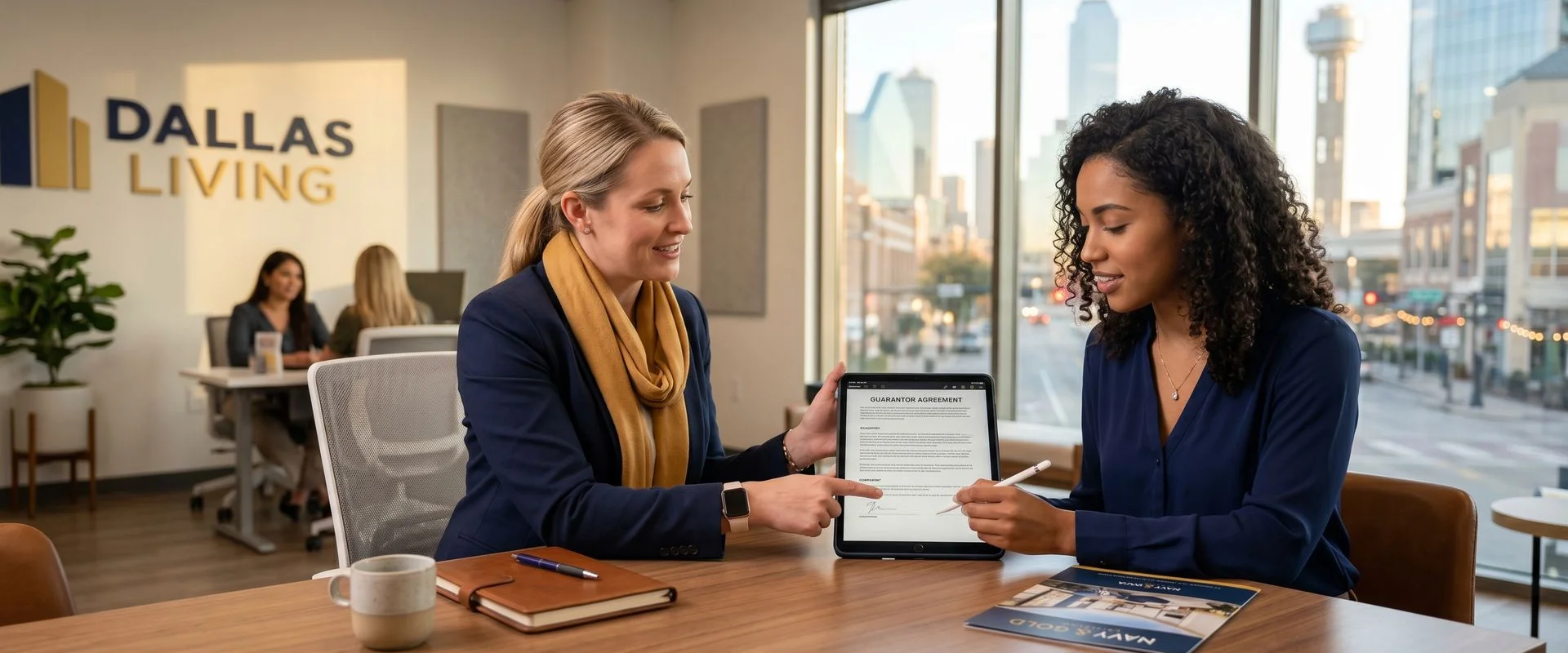
- Third-party guarantor service: Our other main option is a paid platform like TheGuarantors, Liberty Rent, OneApp, Jetty, CoSign or LeaseLock. These companies issue a lease guaranty in exchange for a fee. The landlord gets their required risk mitigation without you asking a relative for a huge favor.
We always warn renters about the hidden income hurdle with personal co-signers. Most Dallas communities in 2026 require a personal guarantor to prove an annual income of 5 times the monthly rent. That math means backing a standard $2,000 apartment requires a relative earning at least $120,000 a year.
Our recommendation is to compare the costs of third-party platforms very closely before applying. Services like TheGuarantors, Liberty Rent or Oneapp typically charge a non-refundable one-time fee ranging from 70% to 110% of a single month’s rent. Platforms like Rhino often offer a smaller monthly payment structure instead.
| Guarantor Type | Typical 2026 Cost / Income Requirement | Best For |
|---|---|---|
| Personal Co-applicant | Free, but requires 3x monthly rent in income | Renters with wealthy, willing family members |
| Guarantor Service | 70% - 110% of one month’s rent (one-time fee) | Fast approvals at Class A, B and C properties |
| Jetty | Smaller monthly fee or personalized premium | Renters wanting to avoid large upfront cash costs |
When You Need a Co-Signer to Get Approved
The guarantor path solves specific approval gaps that income or credit alone cannot clear. Here are the common situations where it is the right move:
- Bad credit, strong current income: We often recommend this route for borderline files. If you are helping a loved one, see Bad Credit Apartment Locating. A guarantor paired with a standard deposit often beats paying a massive risk fee.
- First apartment, no rental history: Our top solution for a missing history is a parental co-signer. Students and recent grads face this issue constantly. See No Rental History Apartment Locating to learn why this works so well.
- Self-employed or 1099 income: We regularly use guarantors for independent contractors. Perfect credit does not equal standard pay stubs in the eyes of a landlord. Read Proof of Income Without Pay Stubs to see how a guarantor substitutes for a documented income trail.
- An older background or eviction record: Our team can also clear past rental mistakes using this method. Current income can offset an older eviction record. The Background-Friendly Apartment Locating guide outlines this specific approach.
We use these strategies across Dallas, Arlington, Plano, and every DFW suburb in our 3,000-community database. Fast approvals mean you secure the keys and claim your $50 rebate faster. The right approach depends on your timeline, budget, and available resources.
Which Dallas-Fort Worth Communities Accept Each Platform
We personally confirm acceptance with each property before you spend money on an application. Acceptance varies heavily by management group and unit class across the region. Newer Class A communities in Uptown mid-rises, Las Colinas, Plano, and Frisco are much more likely to partner with TheGuarantors or Jetty.
Our direct relationships with these top-tier buildings reveal why they prefer corporate guarantees. Large institutional landlords using property management platforms like RealPage or Yardi prefer third-party services because it shifts the financial risk entirely off their internal ledgers. Older garden-style operators in areas like Garland, Mesquite, and Grand Prairie may only accept a traditional personal co-signer because they lack modern software integrations.
Read more about how these specific platforms function in How TheGuarantors, Rhino & LeaseLock Get You Approved. For a direct side-by-side on which path wins out, see Co-Signer vs Guarantor Service: Which Do Dallas Apartments Want?.
The Dallas Second Chance Apartments team is ready to pair your situation with verified guarantor-friendly communities. Simply Tell us your situation and get the process started today. Your custom list will be ready within 24 to 48 hours, saving you time and securing your $50 cash rebate.